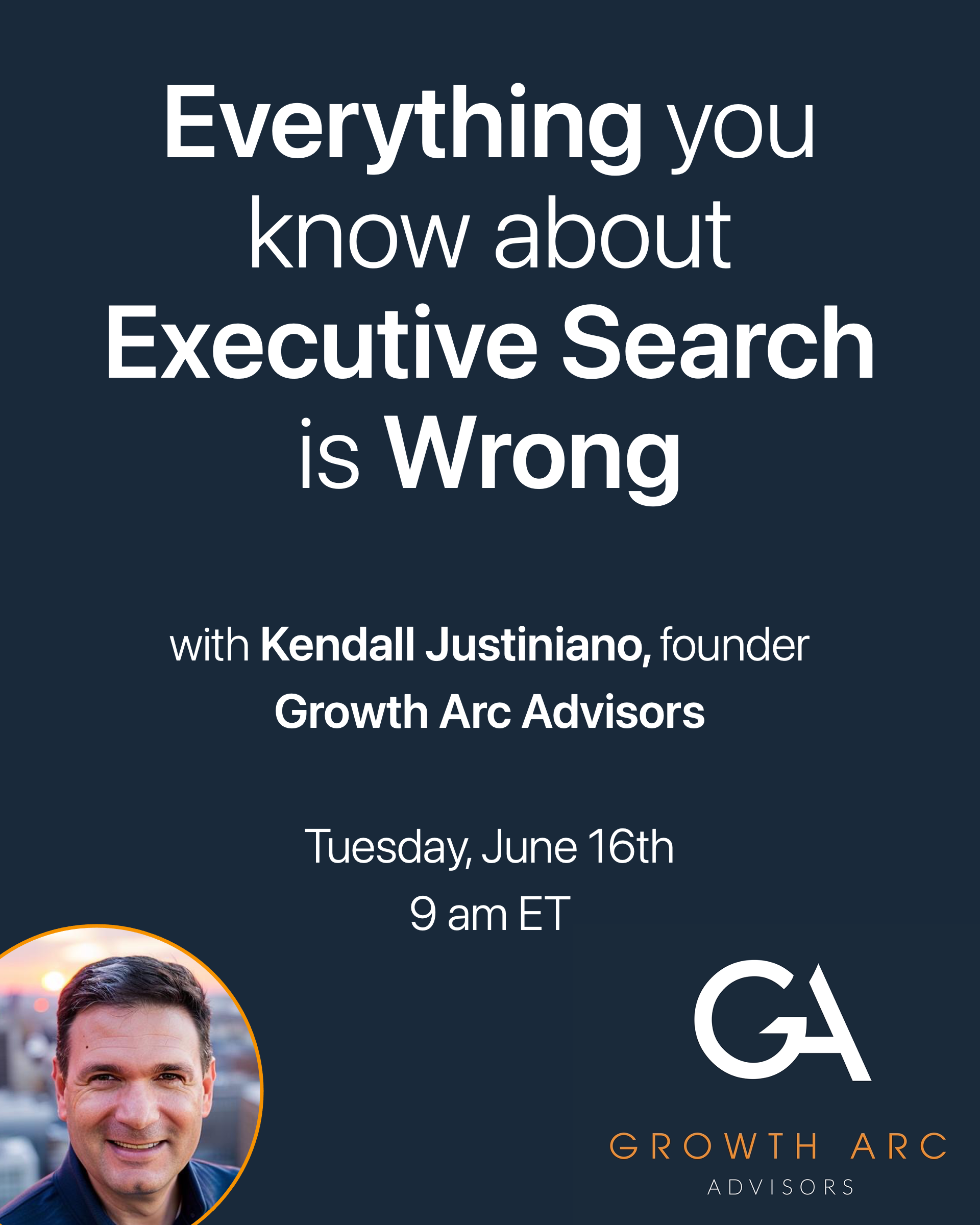
Everything You Thought you Knew about Executive Job Search is Wrong
Thursday, June 16, 2026 · 9:00 AM ET · 60 minutes + Q&A
Live on Zoom · Replay available for 7 days
Register Here - it's Free
Most executive job searches fail not because the candidate wasn't qualified — but because they were playing by the wrong rules.
In two decades as a senior commercial executive in materials, and now as an advisor coaching executives through their own searches, I've watched the same pattern over and over: capable, accomplished leaders running their search the way they were taught to — and getting filtered out at every step by a process that was never designed to surface them.
In this session I want to walk you through eight insights that I believe most senior executives have never heard. Some of them will feel obvious in hindsight. None of them are how most people conduct a search.

Eight insights. Three case stories. One fundamentally different picture of how executive search works.
-
Why the search channels most executives use are the worst ones — and the path that bypasses every filter between you and the hiring decision
-
How an executive resume is fundamentally different from the one that gets you past HR — and why most senior executives have only ever written the second one
-
The insight that turns a cover letter from an application into an offer
-
The story-building methodology behind every leadership narrative on a high-stakes resume — and the part most executives carry in their heads but never put on the page
-
Why the interview at the executive level isn't a capability audit — and what it actually is
-
The single question that consistently shifts an interview from evaluation to peer conversation
-
Why "making your case" is the wrong move in an executive interview — and what works instead
A working example you can take with you.
The session closes with a walkthrough of an actual cold letter, the one that produced a direct call from a CEO who'd never heard of my client, and an invitation to interview for a role that had never been posted.
Every registrant who attends gets the marked-up letter as a PDF the morning after the session with the structural choices called out, line by line. It's the closest thing to a template I'll ever publish.
This session is for you if:
-
You're a director or VP positioning for your next move into an executive role
-
You're a senior executive already in active search
-
You're planning your next move 12–24 months out and want to be ready when the right opportunity surfaces
-
You work in the materials and process industries — chemicals, biotechnology, oil & gas, metals, composites — or an adjacent technical sector
This session is not for you if:
-
You're early in your career and looking for general job search advice
-
You want a generic "how to write a resume" workshop
-
You're hoping for a list of recruiters to call

Kendall Justiniano,
Founder, Growth Arc Advisors LLC
I'm Kendall Justiniano. I spent three decades as a senior commercial executive in specialty chemicals and materials — building and rebuilding commercial businesses across scales from $100M to $700M, in roles spanning aerospace, transportation, and specialty industrial markets.
Today I run Growth Arc Advisors, where I advise materials executives on strategy, innovation, and commercial effectiveness — and where I coach senior leaders through their own executive searches using the methodology I'll be teasing in this session.
The insights I wish I'd heard before my own first executive search.
Each of these insights is one I've either learned the hard way myself or watched a senior executive learn at significant cost. Most of them flip the conventional wisdom about how executive search works — and once you see them, you can't really go back.
If you're at the point in your career where the next move matters more than any move you've made before, this is the session for you.
Hold your Seat - it's Free
I'm not in materials or chemicals.
The methodology applies to any executive search in a technical sector. The examples will lean toward materials, but the insights: going direct, writing for the decision-maker, treating the interview as an influence conversation — translate broadly.
Is this a sales pitch?
The first 40 minutes are content — eight insights, three case stories, a walkthrough of an actual cold letter that produced a CEO call. At the end I'll briefly talk about the group coaching cohort and 1:1 coaching I offer for executives who want to go deeper. If you only want the content, leave at the 40-minute mark. You'll still get the cold letter the next morning.
How much is theory vs. practical?
Each insight comes with a concrete example. The session closes with a real document, the cold letter, and the structural choices that made it work. You'll leave with one thing you can apply immediately.
What if I can't make it?
Register anyway. The replay will be available for 7 days after the event. You'll get the same cold letter PDF.
Will the recording be public after the 7-day window?
No. The replay is for registrants only and closes after 7 days. After that, this material is only available inside the coaching programs.